Mitered Edge Countertops: What They Are & Why They’re Worth It
A mitered edge countertop uses two pieces of stone or porcelain joined at a 45-degree angle to create the appearance of a thick, solid slab without the weight, cost, or structural challenges of using genuinely thick material. This fabrication technique produces a dramatic vertical edge — typically 2 to 4 inches — that elevates kitchen islands, perimeter counters, and bathroom vanities with a bold, contemporary profile. While the visual effect mimics a monolithic slab, the mitered joint allows fabricators to use standard 2cm or 3cm material, making high-end aesthetics accessible without the premium cost of thick slabs.[1]
What Is a Mitered Edge Countertop?
A mitered edge countertop is created by cutting two pieces of countertop material at precise 45-degree angles and bonding them together to form a seamless L-shaped corner. One piece serves as the horizontal surface, while the other forms the vertical edge. When properly fabricated and polished, the seam becomes nearly invisible, giving the impression of a single thick slab. This technique is commonly applied to quartz, granite, marble, and porcelain surfaces.[2]
The process demands precision CNC cutting, careful color and pattern matching, and expert adhesive application. In porcelain especially, the technique proves technically difficult due to the material’s hardness and brittleness — more labor-intensive than working with natural stone and requiring specialized diamond tooling to avoid chipping.[3] Most local fabricators avoid porcelain mitered edges because the learning curve and equipment investment are substantial. At Devenio Design, we’ve invested in the training and tooling to execute porcelain miters consistently, making us one of the few Jacksonville-area shops capable of delivering this look in ultra-compact surfaces.
How Does a Mitered Edge Differ from a Standard Countertop Edge?
Standard countertop edges are shaped from the existing thickness of the slab — typically 2cm (3/4 inch) or 3cm (1-1/4 inch) — while a mitered edge adds a vertical face piece to create a much thicker visual profile, often 3 to 4 inches total. Common standard edges include eased, bullnose, ogee, and bevel profiles, all of which reveal the true slab thickness. These work well for traditional and transitional designs but lack the bold, architectural presence of a mitered edge.[4]
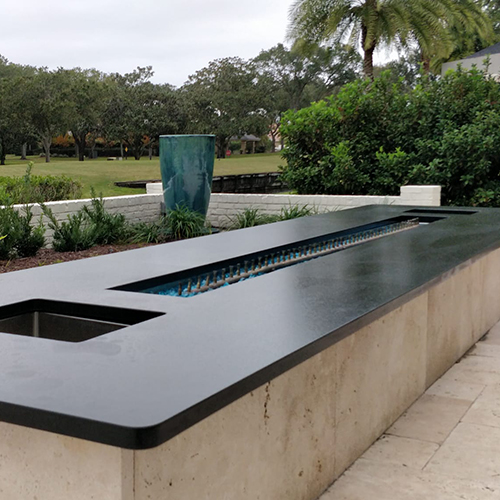
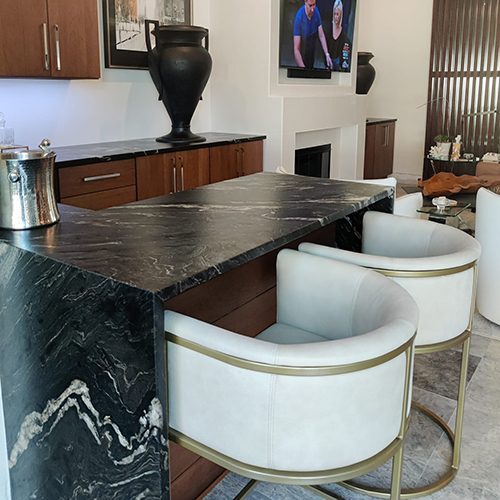
A mitered edge transforms the countertop into a design focal point. The increased thickness adds visual weight and luxury, making it ideal for custom kitchen islands that function as centerpieces. The technique also allows for dramatic waterfall edges, where the countertop material cascades down the sides of cabinetry to the floor, creating a continuous surface. In contrast, standard edges keep the focus on horizontal surfaces and cabinet faces rather than the counter itself.
Why Choose a Mitered Edge Over Thicker Slabs?
Mitered edges deliver the visual impact of a 4-inch-thick slab at a fraction of the cost and weight, eliminating the need for structural reinforcement while preserving design flexibility. Genuine thick slabs — 6cm or more — cost significantly more per square foot, require reinforced cabinetry, and limit pattern and color availability since not all materials are quarried or manufactured in thick formats.[5]
From a practical standpoint, mitered construction keeps total surface weight manageable. A standard 3cm granite island weighs approximately 18 pounds per square foot, while a 6cm slab doubles that load. Mitered edges use the same base material thickness, meaning existing cabinetry and substrate can support the installation without costly structural upgrades. The cost savings are equally compelling: a mitered edge typically adds $30 to $60 per linear foot to your fabrication invoice, while upgrading to 6cm material can increase material costs by 80% or more, assuming your chosen stone or porcelain is even available in that thickness.
What Countertop Materials Work Best for Mitered Edges?
Quartz, granite, marble, and porcelain all support mitered edge fabrication, but success depends on material hardness, pattern consistency, and fabricator skill. Quartz and granite are the most forgiving, with predictable cutting behavior and consistent coloration that simplifies seam matching. Marble requires more care due to its softer composition and veining variability — mitered seams in heavily veined marble demand precise pattern alignment to maintain visual continuity.[6]
Porcelain presents the greatest fabrication challenge and the highest potential for stunning results. Ultra-compact porcelain slabs like Dekton or Neolith are extremely hard and brittle, prone to chipping during cutting and polishing. The material requires slow feed rates, constant cooling, and diamond blades designed specifically for porcelain. However, porcelain’s large-format patterns — bookmatch veining, concrete looks, marble replicas — reward the effort with dramatic, seamless mitered edges. We fabricate porcelain mitered edges regularly for clients in Ponte Vedra and San Marco who want the look of Calacatta marble or Carrara without the maintenance concerns of natural stone.
| Material | Fabrication Difficulty | Seam Visibility | Cost per Linear Foot |
|---|---|---|---|
| Quartz | Low | Minimal | $35–$50 |
| Granite | Low to Moderate | Low | $40–$55 |
| Marble | Moderate | Moderate (veining dependent) | $45–$65 |
| Porcelain | High | Minimal | $50–$70 |
Where Should You Use Mitered Edges in Your Home?
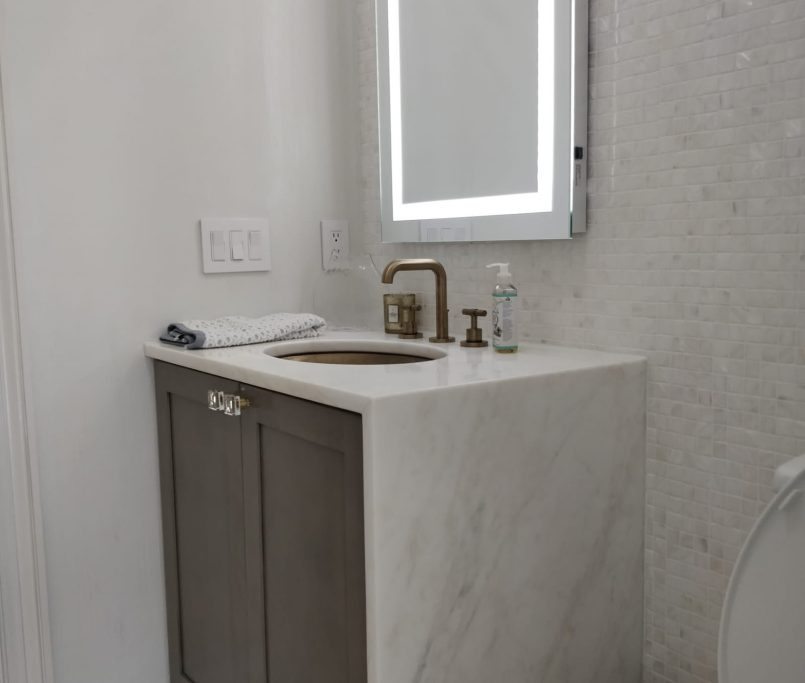
Kitchen islands, peninsula ends, and custom bathroom vanities are the ideal applications for mitered edges, where the thickened profile enhances visual prominence and withstands high-traffic use. Islands benefit most because all four sides are visible, and the added thickness creates a furniture-like quality that anchors the room. Mitered edges also work beautifully on waterfall islands, where the material flows down the side panels to the floor, creating a continuous, sculptural form.[7]
In bathrooms, mitered edges elevate floating vanities and freestanding console sinks, giving them a custom, high-end appearance. We’ve installed mitered porcelain vanities throughout Riverside and Avondale neighborhoods where homeowners wanted a modern aesthetic with the durability to handle daily use. The technique also suits bar tops, desk surfaces, and fireplace surrounds — anywhere the edge profile contributes to the design’s overall impact. Avoid mitered edges on perimeter counters with full backsplashes, where the vertical face remains hidden and the added cost delivers no visual benefit.
Ready to explore mitered edge options for your kitchen or bath? Contact Devenio Design for a free estimate. We offer in-person consultations and virtual estimating — call (904) 524-8240 or visit deveniocustoms.com.
What Does a Mitered Countertop Edge Cost?
Mitered edge fabrication typically adds $35 to $70 per linear foot to your countertop project, with costs varying by material hardness, seam complexity, and local labor rates. A standard kitchen island with 12 linear feet of mitered edge would add $420 to $840 to the total fabrication cost. Porcelain and heavily veined marble sit at the high end due to increased labor and tooling wear, while quartz and granite fall in the mid-range.[8]
That premium is modest compared to the cost of upgrading to genuinely thick slabs. A 40-square-foot island in standard 3cm quartz might cost $2,400 for material and fabrication. The same island in 6cm material — if available — could reach $4,000 or more, plus structural reinforcement. Mitered edges achieve the same visual effect for an additional $500 to $700, preserving your budget for other design priorities like upgraded cabinetry or appliances. When you consider the design impact and cost avoidance, mitered edges represent one of the highest-value upgrades in custom countertop fabrication.
Frequently Asked Questions
What does mitered edge mean for countertops?
A mitered edge is a 45-degree angled joint where two pieces of countertop material meet to form a thick vertical face, creating the appearance of a solid slab without using thick material. The technique produces a bold, architectural edge profile commonly used on islands and vanities.
Is a mitered countertop edge expensive?
Mitered edges typically add $35 to $70 per linear foot to fabrication costs, depending on material type and complexity. While more expensive than standard edges, they cost significantly less than upgrading to genuinely thick slabs and deliver comparable visual impact.
Can all countertop materials have a mitered edge?
Most countertop materials — quartz, granite, marble, and porcelain — can be mitered, but success depends on fabricator skill and material properties. Porcelain is the most challenging due to its hardness and brittleness, requiring specialized equipment and expertise.
How thick does a mitered edge countertop look?
A mitered edge typically creates a 3- to 4-inch thick appearance, though fabricators can customize thickness by varying the width of the vertical face piece. This thickness rivals or exceeds that of genuine thick slabs, which are usually 6cm (2-3/8 inches).
Will I be able to see the seam in a mitered edge?
When properly fabricated, mitered seams are nearly invisible from normal viewing distances. Quality fabrication includes precise cutting, pattern matching, color-matched adhesive, and thorough polishing, making the joint imperceptible except under close inspection.
Mitered edge countertops combine design impact with practical advantages, delivering thick-slab aesthetics without structural complications or material premiums. Whether you’re planning a custom kitchen island or a luxury bath vanity, the technique offers a proven path to elevated design. Contact Devenio Design for a free estimate — call (904) 524-8240 or visit deveniocustoms.com.
Written by Edwina Autrey — Owner & Founder, Devenio Design | Custom Countertop Fabricator, Jacksonville FL | 10+ Years in Construction & Surface Fabrication. Updated January 2026.
References
- Marble Institute of America. Dimension Stone Design Manual. https://www.naturalstoneinstitute.org/
- National Kitchen & Bath Association. Countertop Edge Profile Guidelines. https://nkba.org/
- Tile Council of North America. Porcelain Tile Fabrication Standards. https://www.tcnatile.com/
- American National Standards Institute. ANSI/NSI 373: Natural Stone Design Guidelines. https://www.ansi.org/
- U.S. Geological Survey. Stone Production and Pricing Data. https://www.usgs.gov/
- Quartz Countertop Manufacturers Alliance. Fabrication Best Practices for Engineered Stone. https://www.quartzalliance.com/
- National Association of Home Builders. Kitchen Design Trends. https://www.nahb.org/
- HomeAdvisor. Countertop Installation Cost Guide. https://www.homeadvisor.com/