Waterfall Edge vs Standard Edge Countertop: Which to Choose?
A waterfall edge countertop extends vertically down the sides of a cabinet or island, creating a continuous material flow, while a standard edge countertop terminates at the cabinet face with a profiled edge treatment. The choice between these two styles impacts your project budget, visual statement, and functional layout. At Devenio Design, we fabricate both configurations daily for clients across Jacksonville, from contemporary Riverside lofts to traditional San Marco kitchens. The decision depends on your design goals, material selection, and how you use your space.[1]
What Is the Visual Difference Between Waterfall and Standard Edge Countertops?
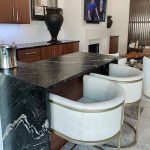
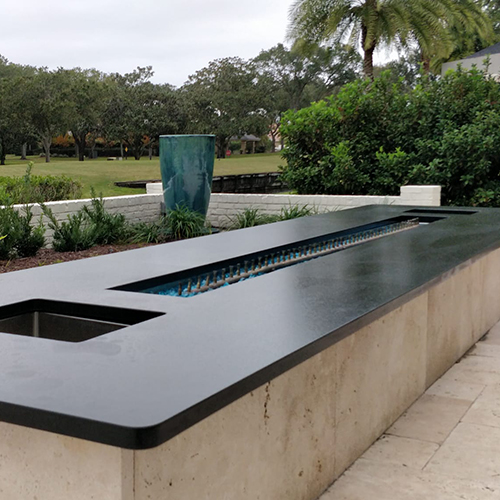
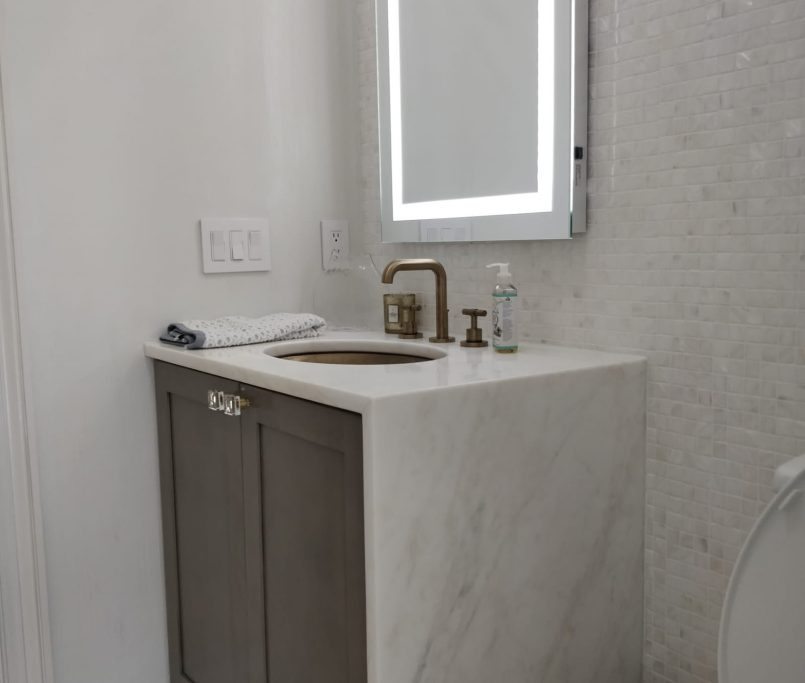
Waterfall edges create uninterrupted vertical surfaces where the countertop material wraps over the cabinet edge and flows to the floor, while standard edges expose the cabinet frame and feature shaped profiles like bullnose, eased, or ogee. This fundamental difference changes how your island or peninsula interacts with the room. A waterfall configuration hides the cabinet structure entirely, presenting the stone or quartz as a sculptural element. Standard edges reveal traditional cabinetry construction and allow decorative profiles to add detail at eye level.[2]
We see waterfall installations most often on kitchen islands in open-concept floor plans where the countertop becomes a focal point visible from multiple angles. The continuous material plane emphasizes the stone’s veining or color movement. Standard edges work best when you want the cabinetry itself to remain prominent or when you’re matching existing countertops in adjacent areas. In Ponte Vedra beach homes, clients frequently choose waterfall islands paired with standard-edge perimeter counters to balance drama with budget.
How Much More Does a Waterfall Countertop Cost?
Waterfall edges typically add 30–50% to island fabrication costs because they require two additional vertical slabs plus precision mitering, seaming, and reinforcement. A standard 8-foot island might use 25 square feet of material, while the same island with waterfall edges consumes 40–45 square feet depending on counter height and material thickness. Labor costs increase substantially because the vertical-to-horizontal seams must align perfectly and support significant cantilever loads.[3]
Material choice amplifies cost differences. Quartz waterfall edges require fabricator-grade epoxy and UV-cured seam bonding, adding 4–6 hours of specialized labor per island. Natural stone like quartzite or marble demands book-matching to maintain vein continuity across the 90-degree turn, which wastes additional material during layout. We typically quote waterfall islands at $180–$240 per square foot installed for premium materials in Jacksonville, compared to $95–$140 per square foot for standard-edge configurations in the same stone. Budget-conscious clients often choose standard edge profiles for perimeter counters and invest in a waterfall feature on a single island.
When Should You Choose a Waterfall Edge Countertop?
Waterfall edges make the most sense for kitchen islands in open floor plans, bar-height seating areas, and spaces where you want the countertop material to function as a design statement rather than a background element. This configuration shines when you’ve selected a stone with dramatic veining or color variation that deserves showcase treatment. The vertical surface protects cabinet ends from foot traffic and chair scuffs in high-use areas, a practical advantage in family kitchens.[4]
We recommend waterfall installations when clients prioritize contemporary or transitional aesthetics, need to conceal appliance panels or storage on island ends, or want to create visual continuity in minimalist interiors. The style works particularly well with integrated sinks and cooktops because it reinforces the countertop as a single functional plane. In San Marco renovations where homeowners are updating 1980s builder kitchens, a waterfall island instantly modernizes the space without requiring full cabinet replacement. However, waterfall edges reduce accessible storage because you lose cabinet access on wrapped sides — a significant tradeoff in smaller kitchens.
What Are the Best Standard Edge Profiles and When Should You Use Them?
Standard edge profiles include eased (lightly rounded), bullnose (fully rounded), bevel (angled chamfer), and ogee (decorative S-curve), each offering different aesthetic and functional characteristics. Eased edges provide a subtle modern look with minimal detail, making them popular for contemporary quartz installations. Bullnose profiles suit traditional and transitional kitchens, offering comfort and safety where children or elderly family members might contact counter edges. Beveled edges add architectural interest without ornate curves, working well in craftsman and industrial-style spaces.[5]
| Edge Profile | Best Applications | Cost Impact | Maintenance |
|---|---|---|---|
| Eased | Contemporary kitchens, minimalist design | Standard rate | Easy to clean |
| Bullnose | Family kitchens, traditional style | +$8–$12/linear ft | No crevices |
| Bevel | Transitional, craftsman, industrial | +$10–$15/linear ft | Moderate |
| Ogee | Traditional, luxury, ornate cabinetry | +$18–$25/linear ft | Requires detail work |
| Mitered | Thick-appearance modern edge | +$35–$50/linear ft | Seam maintenance |
Standard edges allow you to allocate budget toward higher-grade stone or larger surface area rather than labor-intensive waterfall fabrication. In bathroom vanities, we almost always recommend standard profiles because the smaller scale doesn’t benefit from waterfall drama, and the traditional detailing complements fixture hardware and tile work. Ogee and bevel profiles also provide visual weight that balances tall upper cabinets in galley kitchens where an island isn’t feasible.
Which Countertop Materials Work Best for Each Edge Style?
Waterfall edges perform best with large-format quartz slabs, book-matched quartzite, and marbles with linear veining, while standard edges accommodate any material including granite, concrete, and butcher block. The continuous vertical surface of a waterfall installation requires slabs large enough to minimize seams — typically 120 inches × 63 inches or larger. Quartz brands like Caesarstone and Cambria engineer their jumbo slabs specifically for waterfall applications, with reinforced cores that handle cantilever stress.[6]
Natural stone waterfall edges demand careful vein matching. Calacatta marble looks stunning when veins flow continuously around the corner, but achieving this requires purchasing multiple slabs from the same bundle and planning cuts to align patterns. We’ve fabricated waterfall islands in White Macaubas quartzite where the linear striations created seamless transitions, and others in heavily figured granite where the busy pattern made seams too visible. Standard edges forgive pattern mismatches because the vertical cabinet face breaks visual continuity. Materials like concrete, soapstone, and butcher block work better with standard profiles because their fabrication methods don’t produce the large-format slabs waterfall edges require. For budget-conscious projects, we often suggest quartz waterfall edges over natural stone to eliminate vein-matching complexity while still achieving the modern look clients want.
What Practical Considerations Affect Your Edge Choice?
Waterfall edges eliminate toe-kick space on wrapped sides, require careful planning for electrical outlets and plumbing, and make future cabinet modifications more difficult, while standard edges preserve access and flexibility. If your island includes a dishwasher, warming drawer, or cooktop, waterfall sides must account for appliance ventilation and service access. We’ve worked with clients who chose waterfall edges only to discover they needed outlet access on the island end — requiring surface-mounted solutions or costly rework.[7]
Seating arrangements also dictate edge choice. Waterfall sides create a sleek bar-height surface for stools, but the vertical stone reduces legroom compared to standard edges with recessed cabinet bases. In Riverside kitchens where families eat at the island daily, we often recommend waterfall on one end (the visually prominent side facing the living area) and standard edge with knee space on the seating side. Structural support requirements differ significantly: waterfall edges need steel reinforcement brackets hidden inside the cabinet frame, while standard edges rest entirely on the cabinet box. This affects installation sequencing and whether you can retrofit existing cabinetry or need new construction.
Ready to choose the perfect edge style for your project? Contact Devenio Design for a free estimate. We offer in-person consultations and virtual estimating — call (904) 524-8240 or visit deveniocustoms.com.
Frequently Asked Questions
Is a waterfall countertop more expensive than standard edge?
Yes, waterfall countertops typically cost 30–50% more than standard edge installations because they require two additional vertical slabs, precision mitering, and reinforced structural support. Labor time increases by 6–10 hours per island for template refinement, seam alignment, and epoxy bonding. Material waste also increases because vertical pieces must be cut from full slabs rather than remnants.
What materials work best for waterfall edges?
Large-format quartz slabs (120 inches × 63 inches minimum) work best for waterfall edges because they minimize seams and offer consistent color throughout the installation. Book-matched quartzite and linear-veined marbles also perform well when pattern continuity matters. Avoid heavily figured granite or small-format tiles, as seams become too visible on vertical surfaces.
Can I add a waterfall edge to my existing island?
Retrofitting a waterfall edge to an existing island is possible but often impractical because it requires removing the current countertop, adding structural reinforcement inside the cabinet frame, and potentially modifying cabinet dimensions for proper support. Most fabricators recommend this only when you’re already replacing the countertop for other reasons, as labor costs approach new island construction.
Do waterfall countertops work in small kitchens?
Waterfall edges can overwhelm small kitchens by creating visual bulk and reducing usable cabinet access on wrapped sides. In compact spaces under 150 square feet, we typically recommend standard edges with decorative profiles that add detail without sacrificing storage or floor space. Reserve waterfall treatments for islands in open-concept layouts where the feature enhances rather than dominates the room.
Which edge style has better resale value?
Standard edge profiles offer broader buyer appeal and lower replacement costs if damaged, making them safer for resale in traditional markets. Waterfall edges appeal strongly to design-focused buyers in contemporary homes but may deter budget-conscious purchasers due to perceived maintenance costs. In Jacksonville’s upscale neighborhoods like Ponte Vedra, waterfall islands add measurable value; in starter-home markets, the premium doesn’t always return at sale.
Whether you choose the dramatic statement of a waterfall edge or the versatile functionality of standard profiles, proper fabrication determines long-term performance. At Devenio Design, we help Jacksonville homeowners navigate material selection, budget allocation, and design integration for countertops that enhance your daily life. Call (904) 524-8240 or visit deveniocustoms.com to start your free consultation.
Written by Edwina Autrey — Owner & Founder, Devenio Design | Custom Countertop Fabricator, Jacksonville FL | 10+ Years in Construction & Surface Fabrication. Updated January 2026.
References
- National Kitchen & Bath Association. Countertop Edge Profiles: Design and Function Standards. https://nkba.org/design-standards
- Marble Institute of America. Fabrication Guidelines for Natural Stone Countertops. https://www.naturalstoneinstitute.org/standards/
- HomeAdvisor. Cost Guide: Countertop Installation and Fabrication. https://www.homeadvisor.com/cost/countertops/
- International Code Council. IRC Structural Support Requirements for Cantilevered Surfaces. https://codes.iccsafe.org/content/IRC2021P1
- Cambria Quartz. Edge Profile Selection Guide for Engineered Stone. https://www.cambriausa.com/design-details/edge-profiles/
- Natural Stone Institute. Recommended Slab Sizes and Structural Performance by Material Type. https://www.naturalstoneinstitute.org/resources/
- National Electrical Code Article 406.5. Receptacle Outlets Required in Kitchen Countertop Spaces. https://www.nfpa.org/codes-and-standards/nfpa-70